Welcome to the second installment of my eight session course on non-fiction writing. If you haven’t already, why not check out the previous lesson on the market for non-fiction writing and how you can get started.
And now, read on…
Gone are the days when non-fiction writing was synonymous with academic tomes. Thank goodness the ‘experts’ are beginning to realise that informative writing does not have to be turgid and boring. From education to commercial magazines, the tone is casual and familiar. For a great example of children’s non-fiction, check out the Horrible Histories series; I wish it had been around when I was at school! And for a good example of popular non-fiction style for adults, you need go no further than Bill Bryson.
Keep it creative
Nowadays, there is a great deal of crossover between non-fiction and creative writing techniques.
- Storytelling: many books and articles tell their readers a ‘story’ whereby the writer takes the reader on a journey of discovery. Consider yourself a guide rather than a teacher and your writing will immediately become more engaging.
- First person / the authorial ‘I’: In the past, if a non-fiction article or book referred to the author it was always done in ‘third person’. Things have changed and to achieve the more personal touch, many writers insert themselves into the ‘story’ (see ‘Witch Hunt’ in the next section). However, except in an autobiography, be careful that the authorial ‘I’ does not become the main subject of the article. In fact, if you are doing an interview feature or writing a biography of someone else, you have no place in the ‘story’ at all.
- Second person: If non-fiction prose isn’t written in first person, it is often conveyed in second. Second person uses ‘you’ and ‘we’. It is inclusive and ‘democratic’. No one likes being spoken down to, not even by an expert.
- Third person: It is still possible to achieve intimacy in non-fiction prose by using third person, and, at times, it is still appropriate to do so. For more ‘serious’ subjects a first or second person treatment may be too casual or even sound inappropriately flippant. However, when using third person, balance the authorial distance by using an active and engaging writing style.
- Non-fiction as ‘poetry’: Reading non-fiction should never be a turgid experience. Try to add colour to your prose by considering the rhythm and balance of your sentences. Like with poetry, read it out loud to see how it sounds. Use alliteration, assonance, onomatopoeia, imagery, metaphor, but be careful not to become too flowery. The form of the writing should never distract from the information you are trying to convey.
I go into more depth on these and other related topics in my creative writing course.
Keep it casual
One of the main problems new writers have when handling non-fiction is formality. Which of these intros do you prefer?
North East England, like the rest of Europe in the 17th Century, has a shameful history that it would like to hide. But with Halloween just a short broomstick ride away I’ve started hunting for the old witches of Northumbria and found a cauldron-full of dirty secrets.
(From Witch Hunt)
or
The North East of England in the 17th Century had a series of witch hunts resulting in the execution of hundreds of women. This article will tell you more about them.
Hopefully you will agree that the former is far more entertaining without compromising on accuracy. And that’s important. The moment a catchy phrase or chatty idiom gets in the way of communicating the facts, it’s crossed the line.
Who? Where? When? What?
This is the mantra that every journalism student or cub reporter learns on Day One. The key is to get Who? Where? When? and What? into the first two paragraphs and the Why? and the How? will usually be expanded upon in the rest of the article.
Let us take both of the paragraphs above and see how many of the criteria are included.
Paragraph 1
Who? Witches
Where? North East England
When? 17th Century
What? A cauldron full of secrets
Paragraph 2
Who? Witches
Where? North East England
When? 17th Century
What? Witch hunts and executions.
Hopefully from this exercise you can see that an entertaining article can also be an informative one.
Exercise 3:
Take another Who? Where? When? What? intro:‘Scientists believe that changes to gardening practises in the south east of England are due to the affects of global warming.’
Work out the answers to the Who? Where? When? What? questions then rewrite the paragraph in a more entertaining way while still communicating the core information. Keep your paragraph under 40 words.
Keep it concise
To quote Gracian: ‘Good things, when short, are twice as good.’ Most writers overwrite their first draft; that’s fine, the key is to be able to cut back to as few words as possible. Magazine editors will give you a word count; stick to it (a double page article with an illustration is around 1200 words). Book editors will negotiate the word count up front; again, stick to it. And at all cost, cut out any repetition. I say again … just joking!
Exercise 4
Cut this 110 word paragraph down to 60 words without losing the essential information:‘The best violins were made pre-1750, and these are greatly sought after. Names like Stradivarius and Guanerius have taken on mythical proportions, with stories of the discovery of ‘lost violins’ titillating media interest. And of course, the world’s leading violinists only want to play the world’s leading violins. It’s simple economics: a finite supply, an infinite demand. No wonder, in some quarters, it has become such a sordid industry. The great violins were made through a very specialist technology centred in northern Italy with secret knowledge being passed from father to son through a small group of leading violin families. When these families died out, the technology died out too.’
Keep it correct
Non-fiction writing for a popular readership needs to serve the dual purpose of being informative and entertaining. In this course we will not be discussing academic writing, but the rigours of research still apply. Make sure the facts you are giving your readers are accurate. Non-fiction books are expected to cite sources, but that is not always the case in writing for magazines. Each publication I write for has a different attributing style. Some require it in the text, others in footnotes or endnotes and still others not at all (take for example my Witch Hunt article). This does not mean, however, that you can be sloppy with your facts and you should always keep your research in case its validity is questioned.
Ready, steady, go!
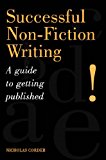 Later in the course we will be looking at writing feature articles and will discuss some more points on structure and style. For an excellent guide see Nicholas Corder’s chapter ‘Writing Your Article’ in Successful Non-fiction Writing. But for now, just work on getting your article or book started.
Exercise 5:
Last week you came up with ideas for articles and books. With these style points in mind, write the opening paragraph of your article or book.
In the next session we will look at writing for the internet.
 Welcome to The Crafty Writer's free online non-fiction writing course, presented by Fiona Veitch Smith, a freelance journalist, editor, author, playwright, screenwriter and writing teacher. I hope that you'll see a dramatic improvement in the quality of your writing as you work through this course.
Pingback: Non-fiction writing for the internet at The Crafty Writer
Pingback: Non-fiction - how to write a feature article at The Crafty Writer
Pingback: Shakespeare: the World as a Stage at The Crafty Writer
how do you write a non-fiction article based on a book which is about refugees?
Same way you write any article, Sam. Look at the session on writing a feature article. You also need to know whether you are writing a review of the book or are just writing an article about the subject matter suggested by the book.
Forget writing, i hardly read books. Probably should blame my affiliation to handicrafts and artwork. Like photography writing is a major part of voicing out ones views while hosting a blog. With an opportunity to write for a magazine, Im here on ur side to learn. Thanks!
I’m a soon to be retired Pastel bookkeeper living in the middle class suburbs of Cape Town, South Africa. I have childhood stories (not so interesting) and financial abuse issues during marriage (divorced now) also helped my daughter deal with and overcome her addiction (my 7 year struggle with an A grade, brilliant artistically creative, kind, loving, adorable daughter – who craved her father’s attention & love).